
2. The Rose Window
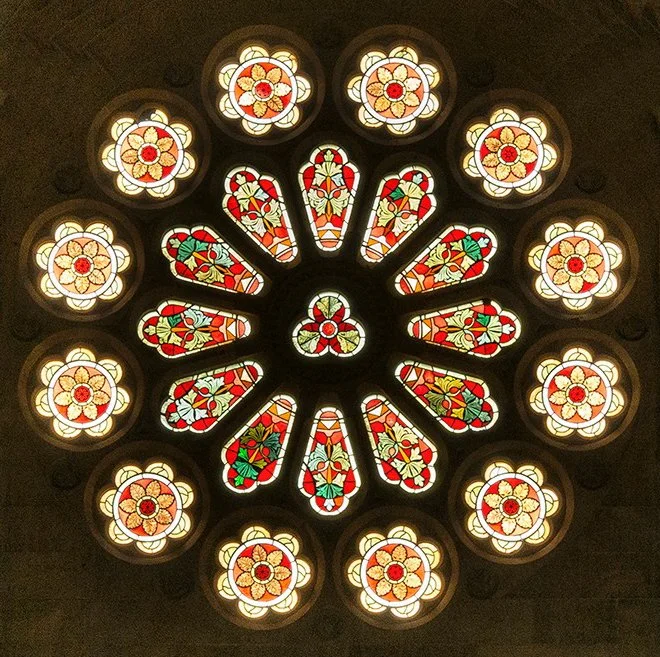
High in the southern wall of the cathedral – above the gallery and over the main door - is the Rose Window. This is the name given to a circular window in a building. Another name for it is a Wheel Window.
Rose windows are a feature of churches that are in the Gothic architectural style. Such churches have soaring towers and impressive stonework – and make use of softly filtered light through stained glass windows. The high towers were supposed to direct people’s attention “up to” heaven.
The Rose Window stands in contrast to the vertical lines and the rectangular-arched windows that predominate in Gothic churches, as they do in our cathedral that is “Gothic revival” in its architectural style. Other Gothic cathedrals famous for their Rose Windows are Notre Dame in Paris and Chartres Cathedral 80 kilometres south-west of Paris.
Edward John Woods became the Cathedral’s architect in 1869 and was influenced strongly by the Gothic style. The Rose Window came as a result of Woods’ adaptation of the original design by William Butterfield.
The design of our Cathedral’s Rose Window is reminiscent of that of the West Rose Window in Chartres. It has a central small feature window (ours is a trefoil) surrounded by twelve radiating decorative panels, and they in turn are surrounded by twelve circular panels. Whereas the Chartres window is full of biblical depictions, our window is purely decorative.
The Rose Window in our cathedral does not contain depictions of any biblical or religious people as do the other stained glass windows here. It was made at the studios of Montgomery and Grimbly of Adelaide and Melbourne in 1901 and appears to be the work of two apprentices whose initials are scratched into the exterior lead cames (the metal chanels that join pieces of glass together). There is one other Montgomery and Grimbly window in the cathedral – that depicting Edward the Confessor.