
13. The Lady Chapel
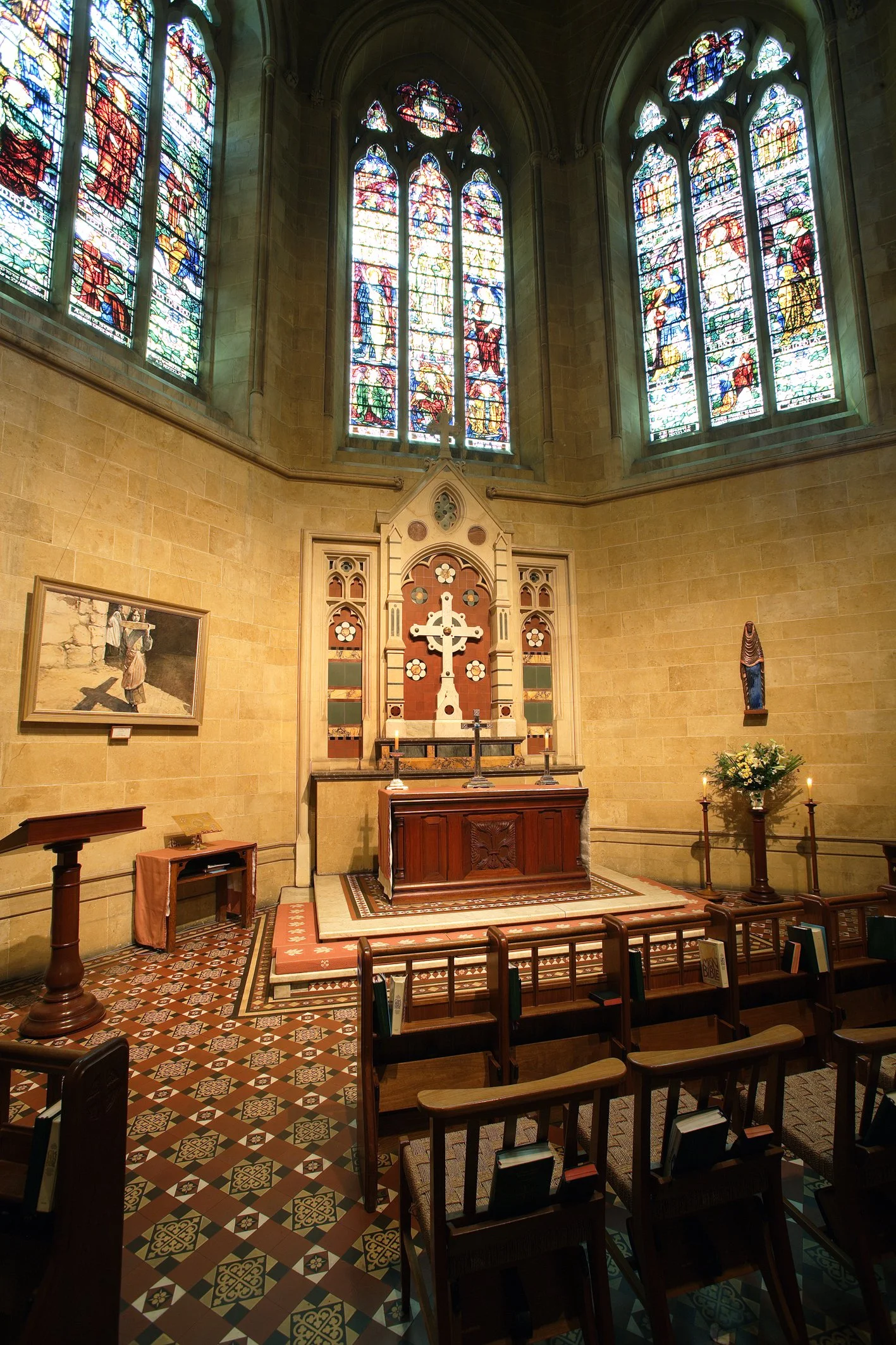
In 1900, local businessman and philanthropist Robert Barr Smith, paid for a semi-octagonal apse to be created at the high altar end of the cathedral in place of the original chancel wall.
Then in 1901, Mrs Priscilla Simms offered to provide funds for a Lady Chapel within the apse to be separated from the Cathedral by three arches supporting a carved wooden reredos. At the same time, a crypt was built beneath the Lady Chapel for use as vestries.
Many Cathedrals have a small worship space dedicated to the honour of Mary, the mother of Jesus, who is often referred to in popular piety as “Our Lady,” hence this space is named “The Lady Chapel.”
The Lady Chapel includes one of the few items from Butterfield’s original design, the marble reredos with its distinctive polychromatic banding. This originally stood against the wall behind the High Altar which was demolished to construct the apse.
Other features in the Lady Chapel include a statue of the Blessed Virgin Mary by Voitre Marek, dedicated in 1977 in commemoration of the Silver Jubilee of Queen Elizabeth II; a painting “Foreshadowing the Cross” by acclaimed Adelaide artist Penny Dowie; and an elegant silver sanctuary lamp (mounted on the back of the reredos) by the Australian sculptor Andor Mészáros.
The Lady Chapel is used for daily worship; as a place for personal prayer and meditation; and as “place of retreat” where people like to come to get away from the hurly-burly of their day and to have somewhere to be quiet and to think or to pray.
THE LADY CHAPEL WINDOWS
The striking stained-glass windows here in the Lady Chapel were a further gift from Robert Barr Smith, originally offered in 1900 at the time he funded the building of the apse.
The windows were made in the prestigious stained-glass workshops of James Powell and Sons (Whitefriars Glass) to designs by John William Brown (1842-1928). Brown had previously worked for the celebrated artist and designer William Morris, and later for James Powell and Sons. He was one of the latter’s preferred designers, especially on important projects.
The windows reveal the strong influence of the Arts and Crafts movement typical of Morris & Co., to the extent that the windows were wrongly attributed to the Morris & Co. for many years.
The window on the right depicts the resurrection of Jesus on Easter Day. The central window depicts “Christ the King,” picking up the theme of the central panel on the reredos and the Christus Rex. The window on the left shows Jesus’ commissioning of his disciple Peter – another scene from the life of Peter that supplements the four seen on the reredos.