The Magdalene Window
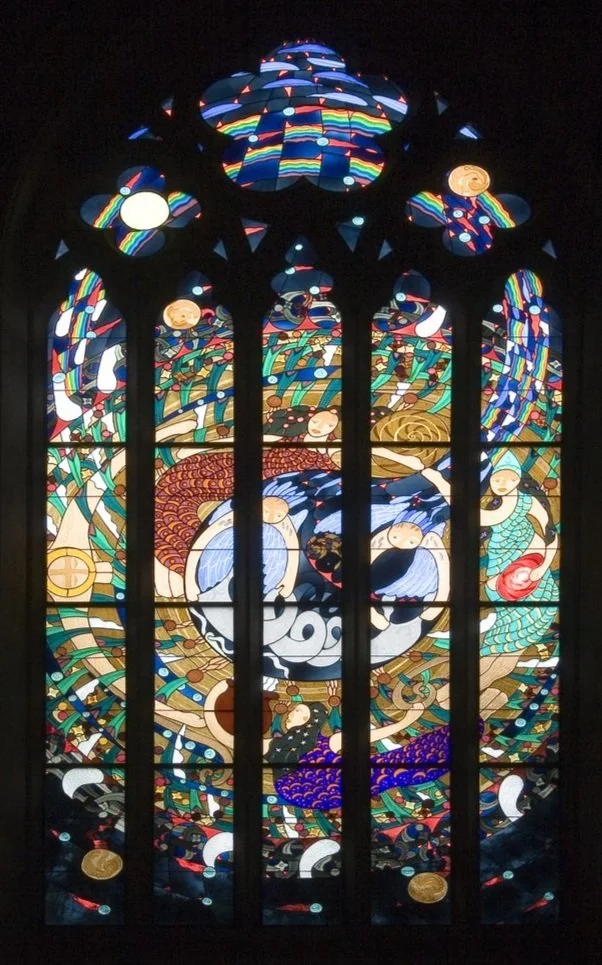
This window acknowledges and celebrates the role of women in the Scriptures, in the history of the Church and in the forefront of social change in South Australia. It was designed and installed by David Wright of Melbourne in 2001 and replaced a large window of frosted glass.
David Wright was born in Melbourne in 1948 and graduated as an architect. He has gained an international reputation for his unique style and glass working techniques, in which the glass is layered and moulded in the kiln, giving a rich colour and texture to his work.
Inspiration for this dynamic design is the theme of Mary Magdalene and the women at the empty tomb. The circle and the spiral are important elements in this window. One circle is that of the circle of the earth which embraces the figures around the tomb, while another circle leads us from the tomb, around the heavens back to the halo of Christ. The strong circular movement is symbolic of the supportive nature of women’s ministry, with the figures bound together with hands out-stretched and integrated with the landscape. God is shown at the centre of the design as a single point. All potential spirals from God.
Mary Magdalene and the women come to anoint Christ’s body at the tomb. One carries a jar filled with aromatic herbs, symbolic of the ‘hands-on’ nature of much of women’s ministry – dealing with the unpleasant aspects of life and death, soothing and making good.
The women find the tomb empty, symbolic of giving birth. Just as women know pain is the prelude to birth, so the pain of the crucifixion precedes the resurrection. The tomb is also symbolic of the womb.
From the spiral of the shroud hangs a needle – symbolic of the manual, caring work which women have traditionally done. In the upper left of the window is a pair of socks, emphasising women’s domestic chores.
Mary Magdalene is the central figure of the window. On her head is a mitre, worn only by bishops. She is symbolic of the place of leadership in the church which women now take. The shepherd’s crook at her feet reminds us of the Pastoral Staff a Bishop carries. She holds a crimson egg. Tradition has it that after the resurrection, when the Emperor Tiberius challenged her story that Jesus was risen, the egg turned crimson.
The circular garden which surrounds the tomb sprouts from seed to leaf to flower in response to the resurrection. The movement of the water through the landscape and the rainbow which winds from the earth through the heavens and back to earth remind us of aboriginal spirituality. The spinning garden is also the earth spinning in space, all one people under God, bound together on this planet.