
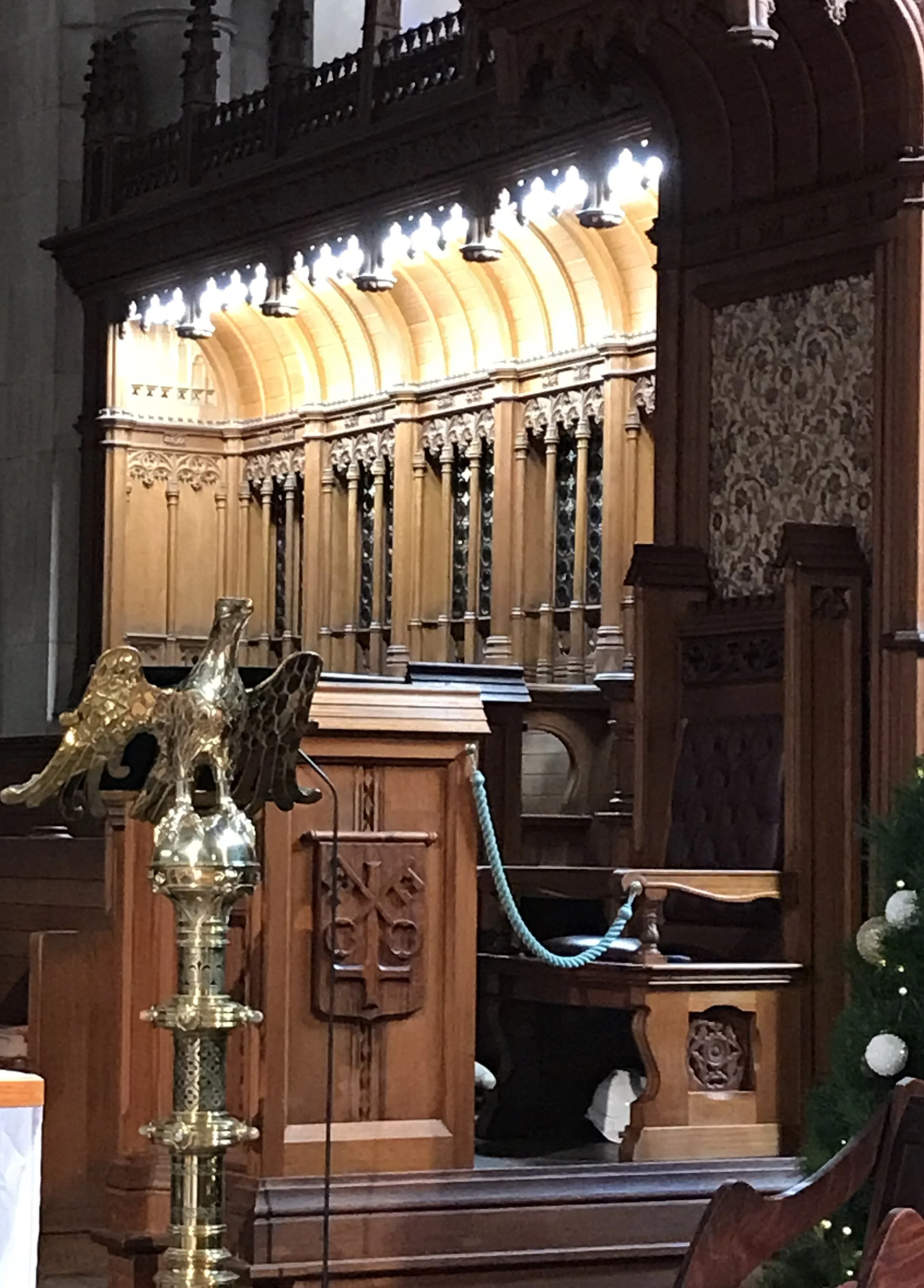
7. The Lectern
The brass lectern in the shape of an eagle with outstretched wings is the reading desk where the Bible is kept, and from where the Bible is read aloud at church services in the cathedral. It was given in 1876 by English friends of Bishop Augustus Short, the first Bishop of Adelaide. It was to commemorate the 25th anniversary of his consecration as bishop. The Latin inscription on the base of the lectern contains a message to that effect.
The eagle-shape is traditional for a lectern. People in mediaeval England thought that the eagle could fly higher and further than any other bird. Therefore it is a fitting symbol for the message of the Bible travelling high and far through all the world with its message of God’s love. The eagle was also believed to be the bird that soared the highest in the sky, and therefore, nearest to heaven.
The eagle stands on a sphere, representing the world.
In its earliest form the lectern was a wooden reading desk. “Lectern” is the old English word for a book-rest. Some very old churches still have wooden lecterns with ancient Bibles chained to them.
The location of the lectern at the front of the church is intentional, for it is the most convenient place for the reader’s voice to be heard. At every service there is a reading from the Bible and the lectern is deliberately placed in front of the congregation so that they may pay attention to it, and in a place of honour because the Bible’s message has a place of honour in the lives and practices of Christian people. In our cathedral the lectern is directly opposite the pulpit … the text of the Bible is read at one, and is explained and applied at the other.