
5. Love of God Window
and the Christus Rex
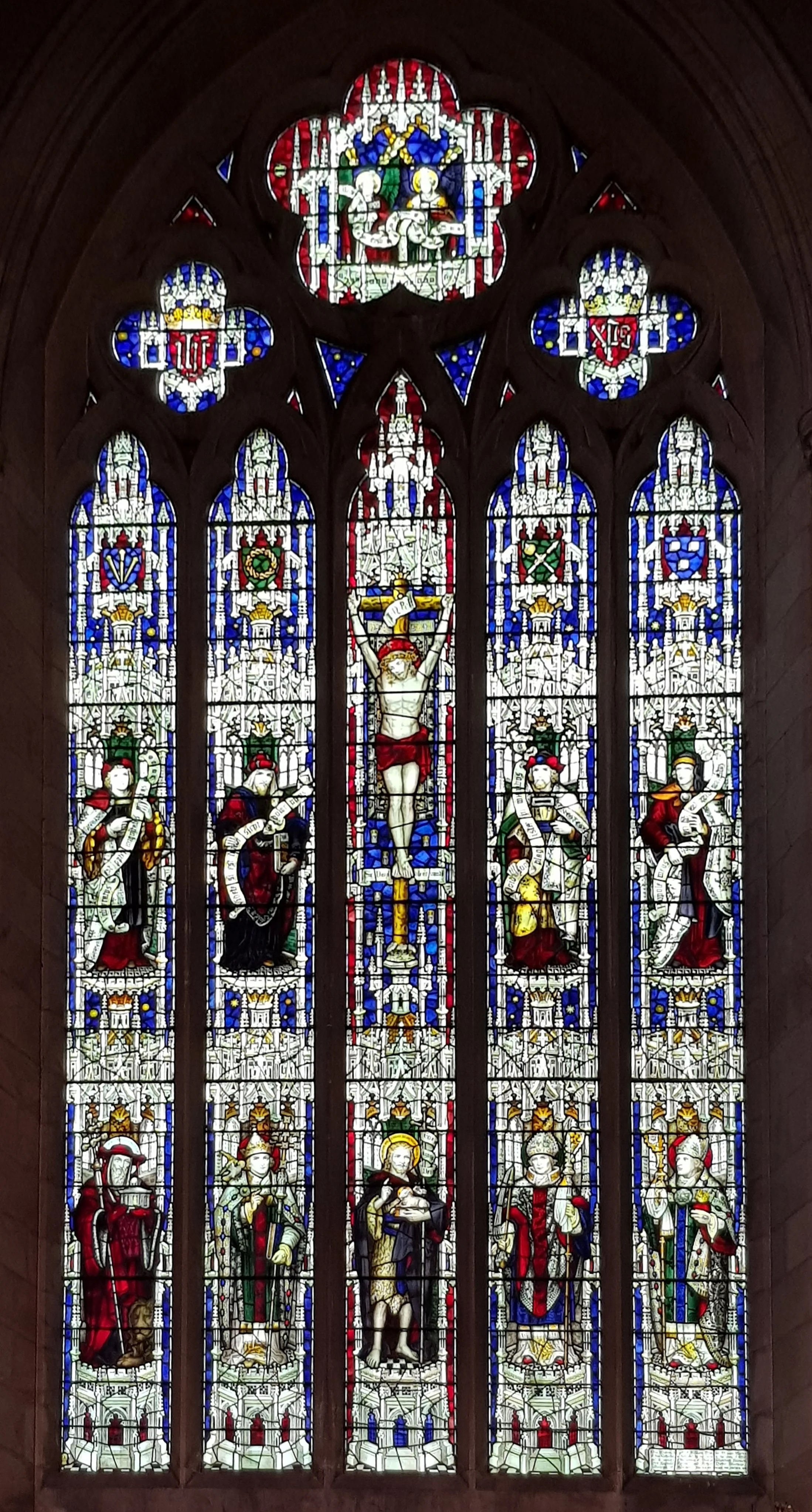
LOVE OF GOD WINDOW
The window is to the left of the pulpit, near the flags. It is a large window with a depiction of Jesus on the cross as its main motif. Jesus is dressed in only a loincloth and wears a crown of thorns as a mockery of the claims he made about his kingship. To the upper left and right of the figure of Jesus, note the images of the nails, the sponge of vinegar, the spear and the dice. These are known as “the instruments of crucifixion” and were a part of the account of what happened at the execution of Jesus.
At Jesus’ feet there is an inscription written in Latin – ‘Ita Deus dilexit mundum’ ‘So God loved the world.’ It is a quotation from the Bible … John 3:16. Hence the title ‘Love of God Window’ for this large, colourful construction.
The figure of the crucified Jesus is flanked to the left and right by four prophets from the Old Testament – Isaiah, Jeremiah, Zechariah and Micah – whose writings contain allusions to aspects of Jesus’ crucifixion. Written in Latin in a scroll in each prophet’s window is a text from his writings that has been interpreted as referring to Jesus’ death on the cross. Isaiah’s scroll contains the words “He was wounded because of our iniquities.” Jeremiah’s has the words, “See if there is any sorrow like my sorrow.” Zechariah’s scroll says “What are these wounds in your hands?” And Micah’s says “O my people, what have I done to you? How have I wearied you? Answer me.” Many of these quotations can be heard in Handel’s Messiah.
Below these figures are depicted four Fathers of the Western Church – Jerome, Gregory the Great, Ambrose of Milan and Augustine of Hippo – whose writings contain explanations of the meanings of Jesus crucifixion.
Immediately below the figure of Jesus is depicted the figure of John the Baptist who prepared the way for Jesus. He is shown dressed in camel skin, and holding a lamb that alludes to Jesus as “The lamb of God who takes away the sin of the world.”
This impressive window was made in London by W.E. Tower of Kempe and Co. It was given in 1926 by William Pope, one of the first Wardens of our cathedral, and was known originally therefore as the Pope Window. It is dedicated to the memory of George Kennion, Reginald Harmer and Arthur Nutter Thomas, three former Bishops of the Diocese of Adelaide.
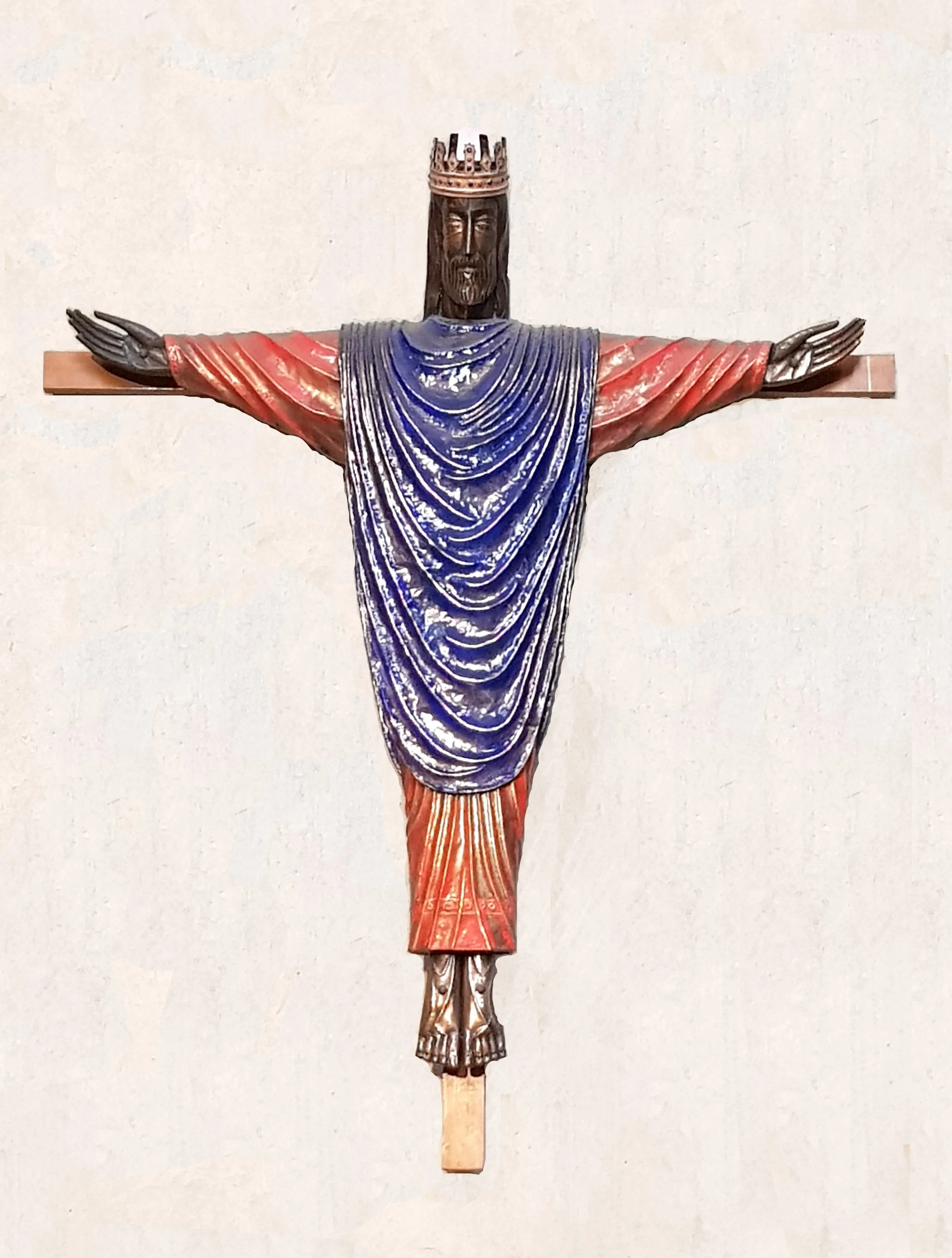
THE CHRISTUS REX
Below the Love of God window is a sculpture known as a ‘Christus Rex’ – ‘Christ the King.’ Here Jesus is again depicted against a cross, but here he is robed in eucharistic vestments and crowned as a king, ‘reigning from the cross,’ in contrast to the stripped figure, crowned with thorns, shown in the window above. He is wearing full royal robes and a royal crown, in stark contrast to the figure in the window above.
The Christus Rex was made by sculptor Voitre Marek for the chapel at St Barnabas Theological College at Belair and was relocated to the cathedral when the college closed. Voitre Marek lived in Prague under the Nazi regime and later migrated to South Australia.
The sculpture was given in memory of Lionel Charles Lenthall by his son the Reverend Ross Lenthall and was dedicated by Bishop Thomas Thornton Reed on June 11 – St Barnabas Day - 1966.
THE FLAGS AND GUIDONS
Guidons (pronounced gee-dons) are swallow-tailed flags carried by Cavalry and Light-Horse regiments. These guidons and flags (or ‘colours’ as they are officially known) have been laid up here in the cathedral by South Australian regiments and battalions for safe keeping in perpetuity. The flags hang here until they disintegrate. These banners will never again be carried in war, a strong symbol of peace; thus they form a suitable and poignant setting for this small space in the cathedral - a space known as the ‘Peace Chapel.’
‘Guidon’ is an ancient word derived from the French guyd homme. This refers to a guide back to their leader and comrades for men who became separated in the confusion of battle. Guidons are carried by Cavalry and Light Horse regiments.
Colours are rectangular and are carried by the Infantry. There are two forms of Colours: The King’s or Queen’s Colour (the Union Flag) denoting loyalty to the Sovereign; and the Regimental Colour marking loyalty to the Regiment. They are consecrated objects, and in times past were looked upon by members of their regiments as symbols of safe refuge.
Modern regiments still have guidons and colours and treat them with great respect. The regiment’s name badge and motto are embroidered on each flag. The most recent was laid up in 2023.